
In 2011, researchers used ultrasound to measure how the layers of the thoracolumbar fascia, the connective tissue sheet in the low back, slide against one another during trunk bending. They tested 121 people, 71 with low back pain lasting more than 12 months and 50 without. Shear strain, a measure of layer-to-layer gliding, was about 20% lower in the pain group: 56.4% versus 70.2%.
It is a real finding, and it is easy to overread. The study compared groups at one time point. It cannot say whether stiff fascia causes pain, whether pain changes how people move and so changes the tissue, or whether both depend on something else.
That gap between a documented property and a claimed cause defines the fascia conversation. Fascia is a genuine and under-studied part of anatomy. It is also the subject of confident claims about release, stored emotion, and whole-body dysfunction that go well beyond the data. Calling it a “newly discovered organ” adds terminology confusion to the problem.
What Fascia Is: A Terminology Problem First
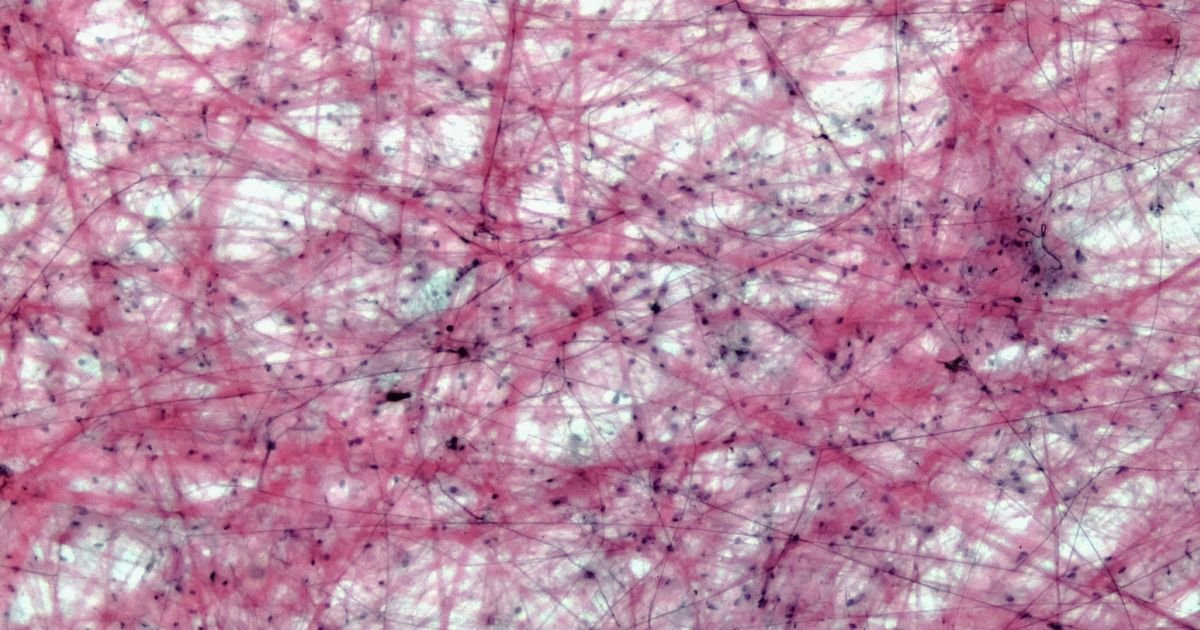
Fascia is a connective tissue network that wraps, separates, and links muscles, tendons, ligaments, nerves, blood vessels, and organs. The difficulty is that experts disagree about where its boundaries lie.
The international anatomical vocabulary, Terminologia Anatomica, was published by the Federative Committee on Anatomical Terminology in 1998, and a second edition followed from its successor body in 2011. It uses a narrow definition and excludes some structures commonly called fascia, such as aponeuroses. Gray’s Anatomy followed the same direction between its 39th and 40th editions. The Fascia Research Society ran a Delphi consensus process that came to a different emphasis. It separated “a fascia,” a discrete sheet, from “the fascial system,” the body-wide connective continuum. Participants noted that a narrow definition suits morphology, while a wider one suits studies of force transmission or sensory function.
Both uses are legitimate. They answer different questions, and comparing studies across them can mislead.
| Structure | Location | Principal components | Established function | Terminology caveat |
|---|---|---|---|---|
| Superficial fascia | Beneath skin | Loose connective tissue, fat | Cushioning, pathway for vessels and nerves | Often called subcutaneous tissue |
| Deep (investing) fascia | Around muscle groups | Dense collagen sheets | Compartment, force distribution | Includes thoracolumbar fascia, fascia lata |
| Muscle layers (epimysium, perimysium, endomysium) | Within and around muscle | Collagen, extracellular matrix | Muscle organization, force transmission | Whether these count as fascia is debated |
| Aponeuroses | Flat tendon-like sheets | Dense collagen | Force transmission | Excluded by some narrow definitions |
| Visceral fascia | Around organs | Loose to dense connective tissue | Support, gliding | Terminology varies by discipline |
The Structure of Fascial Tissue
Fascia is built from an extracellular matrix. Its main fibers are collagen, which provides tensile strength, and elastin, which allows recoil. Fibroblasts and other cells maintain it, and ground substance fills the spaces between fibers. The ratio of dense to loose tissue differs by location, which explains why one sheet is tough and another glides. These properties support structure, force transmission, and tissue movement.
Is Fascia an Organ?
In common anatomical usage, an organ is a structure made of several tissue types working together for a function. Whether fascia fits depends on whether one means a single sheet or the whole system. Sources describe it as an organ, a tissue, a system, or a connective tissue continuum. That is a vocabulary dispute, not a medical discovery.
The idea reached headlines in March 2018. A Scientific Reports paper by Benias and colleagues described an “unrecognized interstitium” of connective tissue spaces in human tissues. It was widely reported as a new organ. Fascia researchers responded that much of this tissue had been studied for years and that the novelty lay mainly in observing it in living tissue. Terminology debates do not prove a new medical discovery, and they do not support new treatment claims.
What Fascia Does
Established roles include structural support, tissue organization, force transmission between muscles, and permitting layers to slide. Evidence also supports a sensory role. Tesarz and colleagues examined the thoracolumbar fascia in rats and humans and found dense sensory innervation, including free nerve endings presumed to be nociceptive. They concluded that the fascia may play a role in low back pain. They also noted that earlier innervation data were inconsistent, so its role as a pain source is hard to assess.
Mechanotransduction, the process by which cells convert mechanical forces into biochemical signals, is also an active research field, and tissues adapt to loading over time. Broader claims, such as fascia as a body-wide communication network that explains remote symptoms, need further validation.
| Proposed function | Mechanism | Evidence type | Confidence | Unresolved question |
|---|---|---|---|---|
| Structural support and compartmentalization | Dense collagen sheets | Anatomy, dissection | High | Boundary definitions |
| Force transmission | Links between muscles and tendons | Anatomical and biomechanical studies | Moderate to high | Clinical relevance of specific chains |
| Sensory and proprioceptive role | Nerve endings in fascia | Tissue studies in rats and humans | Moderate | Contribution to pain |
| Tissue adaptation to load | Cell response to mechanical stress | Cell and animal studies | Moderate | Effect of manual therapy in humans |
| Body-wide fascial communication | Continuity of connective tissue | Hypothesis and indirect data | Low | Whether it drives symptoms |
Fascia, Movement, and Musculoskeletal Pain
Pain has many contributors, including muscles, joints, nerves, connective tissue, and the nervous system’s processing. Attributing pain to fascia generally requires clinical evaluation, since similar symptoms arise from disc, joint, nerve, and muscle problems.
The low back study illustrates both the promise and the limit. Earlier work by the same group found increased thickness and echogenicity of the perimuscular connective tissue in people with chronic low back pain. The 2011 study then found reduced shear strain. The authors suggested the change could reflect altered movement patterns, intrinsic connective tissue problems, or both.
Myofascial Pain and Tissue Sensitivity
Myofascial pain refers to pain thought to arise from muscle and its surrounding fascia, often with tender spots. It is a recognized clinical concept. The distinction to hold is between evidence about a specific condition and the generalization that fascia causes most chronic pain. No evidence in the sources reviewed supports the latter claim.
Aging, Injury, and Adaptation
Connective tissue changes with aging and injury, and loading shapes how it adapts. Physical activity and graded rehabilitation are the main evidence-supported approaches for most musculoskeletal pain, with outcomes judged by function and symptoms rather than by changes in the tissue itself.
Myofascial Release, Foam Rolling, and Other Treatments
Treatments marketed for fascial health include manual therapy such as myofascial release, foam rolling, stretching, and exercise.
| Intervention | Intended outcome | Study evidence | Typical limitations | Safety considerations |
|---|---|---|---|---|
| Myofascial release (manual therapy) | Less pain, better mobility | Systematic review of 8 RCTs: effect sizes did not reach clinically important difference for low back pain or fibromyalgia | Small trials, 5 of 8 at high risk of bias | Generally low risk; avoid on injured or inflamed tissue without advice |
| Foam rolling before exercise | Better flexibility | Meta-analysis of 21 studies: small gain in range of motion, about 4% | Short-term effect | Pressure can bruise or aggravate injury |
| Foam rolling after exercise | Less soreness | Same meta-analysis: small reduction in muscle soreness | Perceived soreness only | Avoid on acute injury |
| Foam rolling for musculoskeletal pain | Reduced pain intensity | 2024 systematic review of 6 trials: 2 showed benefit when added to exercise | Heterogeneous trials, no pooled analysis | Not a substitute for evaluation |
| Exercise and graded loading | Function, strength, pain | Strongest general evidence for musculoskeletal pain | Needs adherence | Progress under guidance |
A 2018 systematic review of myofascial release found eight randomized trials covering lateral epicondylitis, fibromyalgia, low back pain, and heel pain. Three had low risk of bias and five high. Its conclusion was that the evidence was not sufficient to warrant the treatment in chronic musculoskeletal pain. The 2019 Frontiers in Physiology meta-analysis of foam rolling, pooling 21 studies, found small short-term benefits for flexibility and soreness, and negligible effects on jump and strength.
Short-term symptom or range-of-motion improvement does not prove a structural change. Mechanical modeling studies have argued that deforming dense fascia takes more force than manual pressure or a roller delivers. Claims that rolling permanently “breaks up adhesions” are therefore unsupported. Symptom relief may reflect changes in sensation, muscle tone, or expectation. A treatment can help someone feel better without working the way its promoters say.
People with bleeding disorders, blood thinners, osteoporosis, a history of blood clots, or recent injury should ask a clinician before deep pressure techniques. Sharp pain, numbness, or swelling during or after treatment calls for stopping and seeking assessment.
Three questions help with any fascia product or class. Which specific outcome does it claim, and is there a controlled study for that outcome? Does the explanation rely on structural claims that were never measured? What does the provider say about when to see a clinician instead? Honest answers tend to be short and modest.
Myths, Misconceptions, and Research Gaps
| Common claim | What research supports | What remains uncertain | Appropriate interpretation |
|---|---|---|---|
| Fascia is a newly discovered organ | Fascia is long-studied; the “organ” label depends on definition | Boundaries of the term | A terminology debate |
| Fascia causes most chronic pain | Fascia is richly innervated and altered in some pain groups | Cause versus effect | One possible contributor |
| Releasing fascia permanently removes adhesions | Short-term mobility gains in some studies | Structural remodeling in living humans | Symptom change, not proven tissue change |
| Fascia stores emotions | No controlled evidence located | Everything | Not supported |
| Fascia needs routine detoxification | No evidence located | Everything | Not supported |
| Foam rolling prevents injury | Small short-term mobility effects | Injury prevention outcomes | Overreach |
Measuring fascial structure and function in living humans is difficult. Ultrasound elastography, like the technique used in the low back study, offers promise, but results depend on method and posture. Separating fascial effects from muscle, joint, and nervous system responses is a central challenge. Anatomical research is advancing, especially in imaging and terminology, which should make future comparisons more reliable.
What Fascia Research Could Change
Better definitions and measurement could improve rehabilitation research, sports medicine, pain science, and tissue engineering. Promising questions include how loading changes fascial properties, whether specific stiffness measures predict outcomes, and which patients, if any, benefit from targeted manual therapy.
Clinical adoption requires randomized trials with clear outcomes, adequate controls, and follow-up. Research possibilities are not treatment recommendations.
Conclusion: Importance Is Not Proof
Fascia has established roles in structure, movement, and sensation, and research on tissue mechanics and pain is growing. The evidence for specific treatments is thin, and the anatomy does not justify the broad claims made for it. Treatments need evidence beyond anatomical plausibility.
Recognizing that fascia matters is different from claiming it explains every aspect of human health. Precise terms, measured outcomes, and honest uncertainty serve patients better than a single-organ explanation.
Medical Disclaimer: Persistent or severe pain requires appropriate clinical evaluation. This article cannot diagnose the cause of symptoms, and readers should not substitute self-treatment for necessary assessment. Seek urgent care for sudden weakness, numbness, loss of bladder or bowel control, or pain after significant injury.
FAQ
Q: What is fascia in the human body?
A: Fascia is the connective tissue network that wraps and links muscles, nerves, vessels, and organs, made mainly of collagen and a supporting matrix.
Q: Is fascia considered an organ?
A: It depends on the definition. Sources describe it as a tissue, a system, or a connective tissue continuum, and the “organ” label is a terminology debate.
Q: Does fascia play a role in chronic pain?
A: Possibly. Fascia is richly innervated and altered in some pain groups, but evidence cannot yet show it causes most chronic pain.
Q: Can fascia become stiff or restricted?
A: Ultrasound studies found reduced layer gliding in people with chronic low back pain. Whether that is a cause or a result is unknown.
Q: Does myofascial release actually work?
A: A 2018 systematic review judged the evidence insufficient for chronic musculoskeletal pain. Some individuals report short-term relief.
Q: Can foam rolling permanently change fascia?
A: No evidence shows permanent structural change. Studies show small short-term gains in flexibility and soreness.
Q: Does fascia store emotions?
A: No controlled evidence was found to support that claim.
Q: What is still unknown about fascia?
A: Exact boundaries, how to measure function in living people, and whether fascial changes cause symptoms or follow them.