
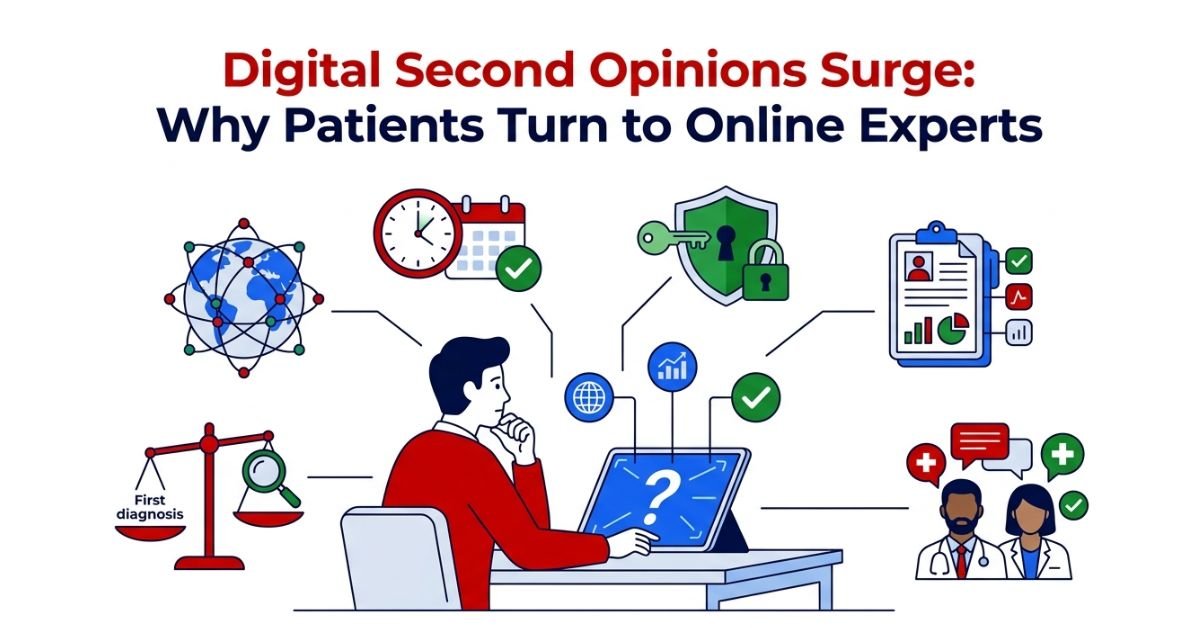
A Mayo Clinic study of 286 patients referred from primary care for a second opinion found the original diagnosis fully confirmed in 12%. In 66%, the diagnosis was refined or better defined, and in 21% it changed distinctly. The patients were referred to one academic center for undifferentiated problems over two years, so the numbers describe a selected group, not all patients.
That caveat shapes the whole topic. Second opinions often change something. Whether the change improves the outcome is a separate question, and the answer depends on the condition, the reviewer, and the records available. A digital second opinion is expert review of a patient’s records, scans, or pathology, delivered remotely. It is neither informal online advice nor an automated symptom checker.
This guide follows the decisions a patient actually faces. Should a review be sought, what should be sent, and who should provide it? What does the evidence say, and how should the result be used with the treating team?
What a Digital Second Opinion Involves
Services differ in format, and the format decides what a reviewer can and cannot do.
| Service type | Workflow | Appropriate use | Limitations | Required records |
|---|---|---|---|---|
| Asynchronous record review | Specialist reviews files, writes a report | Clarify diagnosis or treatment options | No physical exam; incomplete files limit value | Notes, labs, imaging reports |
| Live video consultation | Patient and specialist meet remotely | Discuss options, ask questions | Limited exam | Records sent beforehand |
| Multidisciplinary or tumor board review | Several specialists discuss one case | Complex or rare cancers | Often slower, higher cost | Full imaging, pathology |
| Remote pathology review | Slides or digital images reread | Confirm cancer diagnosis or subtype | Needs slides or scans | Pathology slides or blocks |
| Remote imaging review | Radiologist rereads scans | Confirm findings, staging | Needs original image files | DICOM images, not just reports |
The scope of a service determines whether a physical exam or more testing may still be needed. A remote reviewer can only work with what is sent. If key results are missing, a good service says so and recommends what to obtain.
Why Patients Seek a Second Opinion
Common triggers include diagnostic uncertainty and a serious diagnosis such as cancer. Others are a rare condition, a recommendation for major surgery, a treatment with heavy side effects, and conflicting advice from different clinicians. Access matters too. A patient may live far from a subspecialist, face long waits, or want another expert’s confidence in a plan.
Seeking another opinion does not mean the first clinician was wrong. Many treating doctors encourage it, and some arrange it. Complex cases often have more than one reasonable path, and a second reviewer may simply weigh the options differently.
A Simple Decision Path
Four questions help decide whether a remote review fits.
- Is this an emergency or a condition that needs treatment today? If so, local care comes first and the review waits.
- Is the decision high stakes or uncertain, such as a cancer diagnosis, major surgery, or a rare disease? Review adds most value here.
- Can the question be answered from records, images, and pathology? If it depends on a physical exam, an in-person visit is better.
- Are the records complete? If not, gather them before paying, since gaps weaken any opinion.
Benefit tends to concentrate where uncertainty and consequences are both high. For a routine, well-defined problem with a standard treatment, another opinion is less likely to change anything useful.
How Digital Second Opinions Work
Record Collection and Review
The process starts with consent for records to move. The patient or the treating team collects clinic notes, laboratory results, medication lists, imaging, and pathology. For imaging, original image files carry far more information than the written report. For pathology, the reviewing pathologist often needs slides or blocks.
Incomplete records are the most common limitation. A reviewer may return a list of missing items, or a qualified answer that depends on them. Additional tests may be recommended before a firm opinion is possible.
Specialist Consultation and Multidisciplinary Review
The specialist reviews the file and writes a report with diagnosis, options, and reasoning. In multidisciplinary review, several specialists, such as a surgeon, medical oncologist, radiologist, and pathologist, discuss the case together. The report should state areas of uncertainty and where professionals might reasonably disagree.
Coordination matters. The best reports go to the treating clinician, who knows the patient’s history, preferences, and local resources.
What the Evidence Says About Changes
Studies consistently find that second opinions change something, but the rate varies widely by setting and definition.
| Study | Condition | Sample | Outcome definition | Recommendation change | Clinical outcome | Limitations |
|---|---|---|---|---|---|---|
| Mayo Clinic, 2017 | Undifferentiated primary care referrals | 286 | Final versus referral diagnosis | 12% confirmed, 66% refined, 21% distinctly different | Not measured | Single center, retrospective, selected referrals |
| Stanford oncology online program, 2018 to 2020 | Cancer, mostly advanced | 657 | Treatment change recommended | 53.8% any change; 33.9% major | Not tracked | Did not follow whether local doctors acted |
| Review cited by KFF Health News | Mixed | Multiple studies | Major diagnosis or treatment change | 10% to 62% across studies | Varied | Heterogeneous definitions |
| Best Doctors service analysis, cited by KFF | Mixed, employer benefit | Nearly 6,800 | Diagnostic or treatment change | More than 40% | Varied | Service population, not general public |
In the Stanford program, a report arrived within three days, and treatment change was recommended most often for stage II disease, at 64%. Examples of major changes included intensifying treatment for metastatic prostate cancer and avoiding chemotherapy in early breast cancer based on genomic testing. The authors did not track whether patients’ local providers followed the new advice.
Vendor-reported figures run higher. Cleveland Clinic’s virtual second opinion program, a joint venture with Amwell, has been described in company-linked materials as recommending a diagnosis or treatment change in 67% to 70% of reviewed cases. These are promotional or commissioned figures, not independent trials, and they should not be read as typical.
A change in recommendation is not evidence of better outcomes. A refined diagnosis may add detail without altering treatment. A different treatment recommendation may be better, equivalent, or worse. Few studies follow patients long enough to compare survival, complications, or quality of life with and without a second opinion. Referral selection also inflates apparent change rates: people who seek another opinion often have complex or unclear problems.
Patient follow-through varies. In a survey reported by KFF Health News, 61.2% of respondents said they agreed or strongly agreed they would follow the recommendations they received. Another reason to coordinate with the treating team.
Benefits, Limits, and Risks
| Potential benefit | Potential risk | Affected users | Mitigation | Evidence strength |
|---|---|---|---|---|
| Access to a subspecialist | Opinion based on incomplete data | Rural or distant patients | Send complete records and images | Moderate |
| Clarified options for complex decisions | Conflicting advice, decision paralysis | Patients with serious diagnoses | Discuss with treating clinician | Moderate |
| Reduced travel and wait | No physical exam | Those with limited mobility | Confirm scope in advance | Moderate |
| Possible avoided or added treatment | Delay of treatment while waiting | Time-sensitive conditions | Set a short review deadline | Low to moderate |
| Reassurance when diagnosis confirmed | False reassurance if records incomplete | Anxious patients | Ask what limits the opinion | Low |
Costs deserve a direct question. Earlier coverage by KFF Health News reported fees of several hundred dollars at a major academic center, and noted that in-person specialist visits are more likely to be covered by insurance than online consults. Current fees and coverage change, so ask for the total in writing.
Remote review may be unsuitable for emergencies, conditions that need an in-person exam, or situations where immediate treatment is required. Fragmented care is the quiet risk: opinions that never reach the treating team can leave a patient with two plans and no one coordinating either.
| Criterion | Digital review | In-person review | Situations requiring physical assessment |
|---|---|---|---|
| Physical examination | Not possible or limited | Possible | Abdominal pain, neurological deficits, wound or joint assessment |
| Speed | Often days | Often weeks | Urgent cases favor local care |
| Convenience | High | Travel needed | Patients unable to travel favor digital |
| Access to subspecialists | Broad | Limited by geography | Rare diseases favor digital reach |
| Additional testing | Must be arranged locally | Often done on site | When new tests are needed |
How to Choose a Reliable Service
Several checks reduce risk.
- Credentials: confirm the reviewing specialist’s board certification and subspecialty
- Licensure: in the United States, physicians generally need to be licensed where the patient is located, and some states have licensure compacts, so check the service’s arrangements
- Affiliation: look for a recognized hospital or academic center, and ask who the actual reviewer is
- Privacy: ask how records are stored, who sees them, and whether data is used for research or shared with third parties
- Cost and scope: get fees, what the fee includes, turnaround time, and whether follow-up questions are included
- Report: confirm a written report is delivered and can be shared with the treating clinician
India’s Telemedicine Practice Guidelines of 2020 set rules for remote consultation by registered medical practitioners, and cross-border services raise additional licensing and legal questions. For any service across state or national borders, check which rules apply before paying.
| Evaluation criterion | Evidence to verify | Why it matters |
|---|---|---|
| Reviewer credentials | Board certification, subspecialty, license | Opinion quality depends on the reviewer’s expertise |
| Records required | Written list of needed documents | Incomplete files produce weaker opinions |
| Privacy terms | Storage, sharing, research use | Health records are sensitive |
| Cost | Total fee, what is covered | Insurance often does not cover online reviews |
| Turnaround | Stated days to report | Time-sensitive conditions need speed |
| Follow-up | Q and A with the reviewer | Reports can raise new questions |
Documents to Prepare
A typical file includes recent clinic notes, a medication list with doses, all laboratory results, imaging reports and original image files, pathology reports and slides when relevant, prior treatment history, and a short summary of the question the patient wants answered. A one-page timeline helps the reviewer.
Using the Report With the Treating Team
Share the report promptly. Ask the treating clinician to compare the two plans, explain differences, and agree on next steps. Disagreement between experts is common in complex care. The patient’s goals, risk tolerance, and local resources help decide the path.
Conclusion: One Coherent Plan, Not Several Disconnected Opinions
A second opinion can improve decision quality by clarifying a diagnosis, laying out options, and naming uncertainty. It also gives patients a clearer view of what questions to bring back to their own team. Secure record sharing and coordinated follow-up make it work. Evidence that recommendations change is strong. Evidence that outcomes improve is thin, and patients should not read a changed recommendation as proof of error or of a better plan.
The aim is integration. Additional expertise helps when it flows into one treatment plan that the treating clinician and patient both understand.
Medical Disclaimer: Second opinions do not replace emergency assessment or the treating clinician’s ongoing care. Patients should not delay urgent treatment while arranging a remote review.
FAQ
Q: What is a digital medical second opinion?
A: It is a remote review of a patient’s records, images, or pathology by a specialist who gives an independent assessment.
Q: When should patients seek a second opinion?
A: Common reasons include a serious or rare diagnosis, uncertainty, a major surgery recommendation, or conflicting advice.
Q: Can an online specialist review medical records?
A: Yes, if they receive complete records. Imaging and pathology often need original files, not only reports.
Q: How often do second opinions change treatment plans?
A: It varies widely. One review found major changes in 10% to 62% of cases, and a Stanford oncology program recommended a change in 53.8%.
Q: Are digital second opinions as reliable as in-person reviews?
A: They can be equivalent for record-based questions. They cannot replace a physical exam when one is needed.
Q: What records should patients prepare?
A: Clinic notes, medications, labs, imaging files, pathology, and a short timeline with the question to answer.
Q: Can a second opinion be obtained across state or national borders?
A: Sometimes, but licensing and legal rules differ. Confirm the reviewer’s authorization before paying.
Q: How should patients discuss conflicting recommendations with their doctor?
A: Share both reports, ask the doctor to explain differences, and decide together using the patient’s goals and risks.