By the time hospitals fill up, an outbreak is already weeks old. That is the old reality of disease tracking, which counted cases after the damage began. Today, wastewater signals, AI models, and forecasting centers are turning surveillance into early warning. Here is how prediction works, what it has delivered, and where it still falls short.
From Rearview Mirror to Weather Forecast
Traditional surveillance relies on reports. A patient gets sick, visits a doctor, takes a test, and a lab reports the result. Each step adds days or weeks.
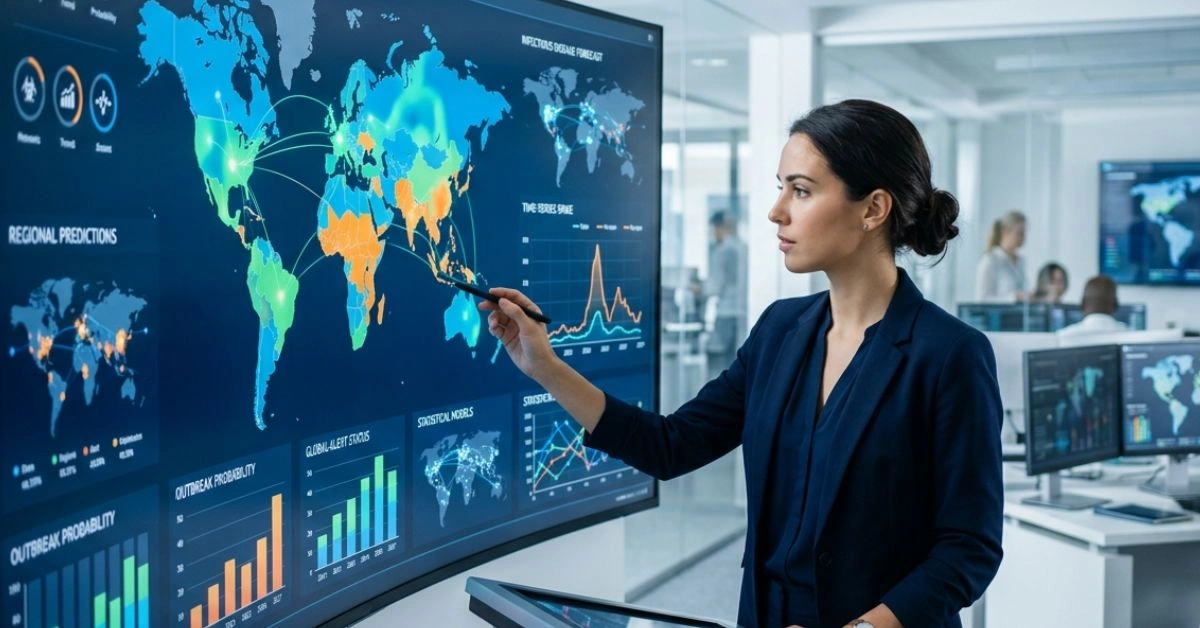
Predictive surveillance flips the timeline. It combines faster signals and statistical models to estimate what will happen next, much like a weather forecast.
The CDC says its Center for Forecasting and Outbreak Analytics is working to make outbreak forecasting as routine as weather forecasting. The idea is to give leaders time to act before hospitals are overwhelmed.
| Feature | Traditional Surveillance | Predictive Surveillance |
|---|---|---|
| Main question | What happened? | What happens next? |
| Data sources | Lab reports and hospital counts | Wastewater, symptoms, mobility, news, genomics |
| Speed | Days to weeks behind | Near real time |
| Output | Case counts and trend charts | Forecasts with ranges of uncertainty |
| Action window | After spread begins | Before surges peak |
The Data Streams Behind the Forecasts
No single signal is enough. Modern systems blend many data streams, a method CDC calls signal fusion.
| Data Stream | What It Reveals | Speed Advantage |
|---|---|---|
| Wastewater testing | Virus levels across a whole community | Often ahead of clinic and hospital data |
| Emergency department visits | Rising fever, cough, or rash complaints | Days ahead of lab confirmation |
| Lab and genomic sequencing | Which variant or strain is spreading | Identifies new threats quickly |
| Search and social data | Public symptom interest | Early but noisy |
| Travel and mobility data | How people move between regions | Predicts geographic spread |
| Animal and environmental data | Spillover risk from wildlife and livestock | Warns of new threats |
Each stream has weaknesses. Combining them reduces blind spots and false alarms.
Wastewater: The Early Warning Superpower
Wastewater surveillance may be the biggest recent breakthrough. People shed viruses in stool and urine whether or not they get tested, so sewage offers an unbiased snapshot of a whole community.
The CDC’s National Wastewater Surveillance System began in 2020. CDC explains that wastewater data are often available within a week of sample collection, while hospital admissions can take a week or more to be reported.
CDC even uses wastewater alongside hospital data to forecast COVID-19 admissions, the first time wastewater was built into its forecasts. Learn more in the CDC page on wastewater-informed forecasting.
The Associated Press reported in January 2026 that one study found measles in wastewater about 10 weeks before the first cases were reported. That is an enormous head start.
| Wastewater Advantage | Why It Matters |
|---|---|
| Captures people who never get tested | Shows true community spread |
| Fast turnaround | Supports quick decisions |
| Low cost per person monitored | Efficient for large populations |
| Can test for many pathogens | One sample covers several threats |
| Protects privacy | Measures communities, not individuals |
For more detail, see our explainer on how wastewater epidemiology tracks disease outbreaks.
AI and Machine Learning Join the Team
Artificial intelligence can sift through huge, messy data sets faster than any human team. It can spot subtle patterns, such as a slight rise in fever complaints in one region, and flag them for review.
Research in this field is moving quickly. For example, scientists have tested models that forecast COVID-19 trends from wastewater data over multiple years, finding that results improve when models are tuned to specific regions.
The Canadian company BlueDot is often cited as an early example. Its system reportedly flagged the unusual pneumonia cluster in Wuhan before most public health agencies issued warnings.
| AI Task | What It Does | Example Benefit |
|---|---|---|
| Anomaly detection | Flags unusual spikes in symptoms or visits | Earlier alerts |
| Forecasting | Predicts case and hospital trends | Better resource planning |
| Genomic analysis | Tracks mutations in viruses | Faster variant detection |
| News and social monitoring | Scans reports in many languages | Finds early rumors of outbreaks |
| Risk mapping | Combines climate, travel, and population data | Targets prevention efforts |
To explore the methods, read our guides on data science for predicting and preventing disease outbreaks and applications of data science in pandemic prevention.
Who Is Building the System?
Government agencies, universities, and private companies all play a role. In the United States, the CDC’s forecasting center brings together modelers, emergency responders, and communicators to turn data into decisions.
Funding has also supported a network of research centers that test forecasting methods. CDC invested hundreds of millions of dollars in this effort, including 13 research centers across the country, according to Becker’s Hospital Review.
| Player | Role |
|---|---|
| CDC forecasting center | Produces national forecasts and supports outbreak response |
| State and local health departments | Collect local data and act on warnings |
| Universities | Build and test new models |
| Private companies | Offer wastewater testing and analytics tools |
| Hospitals | Provide real-time clinical data |
| International agencies | Share global signals and genomic data |
Real-World Applications
Predictive surveillance is not limited to pandemics. It supports everyday public health.
| Disease or Threat | How Prediction Helps |
|---|---|
| Seasonal flu and COVID-19 | Hospitals plan beds, staff, and supplies |
| Measles | Faster outbreak detection and vaccination campaigns |
| Avian flu | Tracking spread among animals and humans |
| Mpox and emerging viruses | Targeting testing and vaccines |
| Antibiotic resistance | Spotting resistant bacteria early |
| Climate-sensitive diseases | Anticipating mosquito and tick seasons |
These threats are real. Read our reports on measles resurgence and why vaccination matters, the mpox outbreak and global response, and antimicrobial resistance as a global threat.
Climate also changes where diseases spread. See our analysis of climate change impact on public health.
Planning for the Unknown
Prediction is especially valuable for the unexpected. Experts warn that new pathogens will appear, but no one knows exactly when or where.
Our features on the next pandemic and Disease X explore why preparedness matters.
The Limits: Why Forecasts Can Fail
Forecasting is hard, and humility matters. Models depend on data quality, and diseases do not follow neat rules.
A famous cautionary tale is Google Flu Trends. It once overestimated flu activity because search behavior changed, a reminder that clever signals can mislead.
| Limitation | Why It Happens | Safeguard |
|---|---|---|
| Sudden shifts | New variants or behavior changes break patterns | Update models frequently |
| Data gaps | Some regions test and report less | Add wastewater and other sources |
| Biased data | Underrepresented groups may be missed | Include diverse communities |
| Overconfidence | Single forecasts can seem too certain | Show ranges and uncertainty |
| Funding risk | Programs depend on steady support | Long-term, stable investment |
Funding is a real concern. The Associated Press reported that a budget plan would cut the national wastewater system’s funding from about $125 million a year to about $25 million. You can read the AP report on the value of wastewater surveillance.
Privacy and Ethics
Surveillance can raise legitimate worries. Wastewater data are community level, which protects individuals. Other sources, like phone location and health records, are more sensitive.
| Concern | Why It Matters | Good Practice |
|---|---|---|
| Location tracking | Movement data can reveal private behavior | Use anonymized, aggregated data |
| Health records | Personal details are highly sensitive | Strong security and limited access |
| Stigmatizing communities | Neighborhood data could be misused | Transparent rules on use |
| Public trust | People resist surveillance they do not understand | Clear communication |
Learn how health information is protected in our guide to healthcare data privacy. Predictive tools are also expanding into patient care, as our look at predictive analytics in healthcare shows.
What You Can Do
Surveillance depends on communities, but individuals matter too.
| Action | Why It Helps |
|---|---|
| Stay up to date on vaccines | Reduces the spread of preventable diseases |
| Check local wastewater and respiratory dashboards | Shows current community risk |
| Stay home when sick | Slows spread |
| Get tested when advised | Supports accurate data |
| Support local public health funding | Keeps early warning systems running |
Conclusion: Seeing Trouble Before It Arrives
The solution is a layered system. Wastewater, clinical data, genomics, and AI should work together, supported by steady funding, transparent rules, and honest communication about uncertainty. No single tool is enough, but together they can shrink the time between first spark and first response.
Looking ahead, expect forecasts that cover more diseases, smarter models, and tighter links between community data and local action. If governments keep investing and the public stays engaged, predictive surveillance may turn many future outbreaks into manageable events.
Frequently Asked Questions
Can scientists really predict outbreaks?
They can estimate likely trends, often with useful accuracy over short horizons. Long-term predictions are less certain.
Is wastewater testing invasive?
No. It tests community sewage, not individual people.
Will predictive surveillance prevent the next pandemic?
It cannot prevent every outbreak, but earlier detection gives responders more time to act.
This article is for general information only and is not medical advice. Follow guidance from your local health department.