Most cancers have no routine screening test. They are often found only after pain, weight loss, or a scare sends someone to the doctor. A new generation of blood tests promises to change that by spotting tumor signals early. The promise is real, but the evidence is more complicated than the headlines.
The Screening Gap These Tests Aim to Fill
Screening works well for a handful of cancers, such as breast, colon, cervical, and lung. For many others, no recommended test exists.
According to the Galleri test’s developer, only about 14% of cancers in the United States are typically found by guideline-recommended screening. Most others are found after symptoms appear, often at later stages.
| Cancer Type | Recommended Screening Today | Gap |
|---|---|---|
| Breast | Mammography | Covered, but not everyone is screened |
| Colorectal | Colonoscopy, stool tests, blood test | Covered, with low participation |
| Cervical | Pap and HPV tests | Covered |
| Lung | Low-dose CT for high-risk people | Limited to heavy smokers |
| Pancreatic | None for average-risk people | Often found late |
| Ovarian | None for average-risk people | Often found late |
| Stomach, liver, esophageal | None for most average-risk people | Often found late |
How Blood Tests Detect Cancer
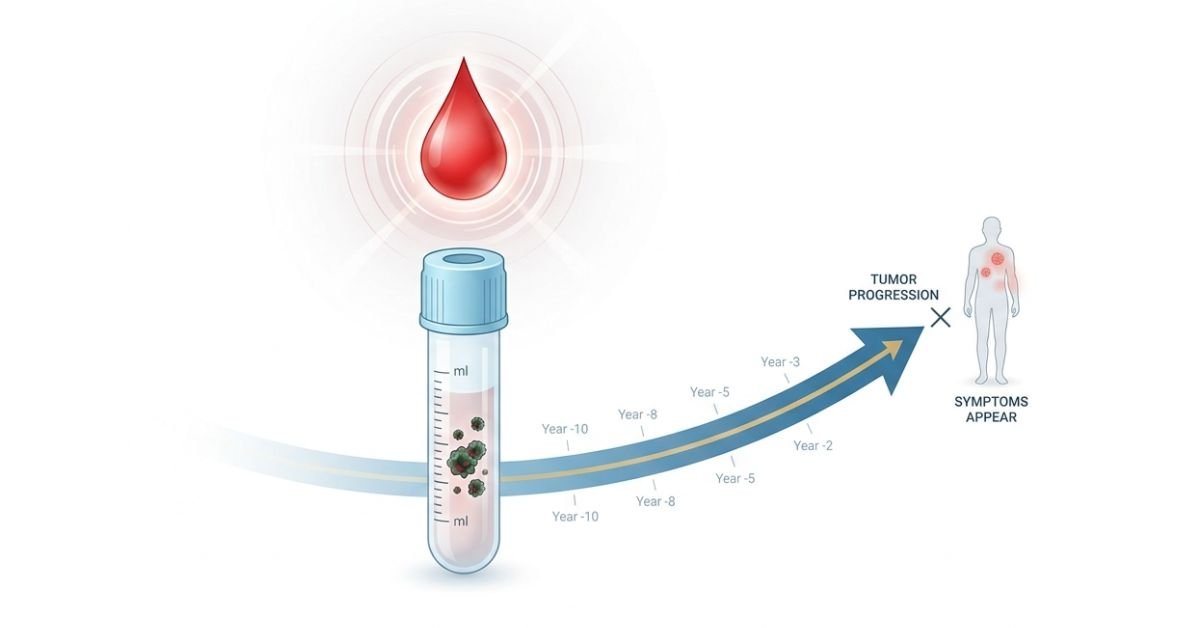
Tumors shed tiny fragments of DNA into the bloodstream. These fragments, called circulating tumor DNA, carry chemical patterns that differ from healthy DNA.
Tests look for those patterns. Some also predict where in the body the signal came from, so doctors know where to search.
| Step | What Happens |
|---|---|
| 1. Blood draw | A routine sample is taken at a clinic or lab |
| 2. Lab analysis | Machines scan DNA fragments for cancer-linked patterns |
| 3. Algorithm | Software decides whether a cancer signal is present |
| 4. Signal origin | Some tests predict which organ is involved |
| 5. Follow-up | A positive result leads to imaging and other tests |
Importantly, a positive blood test is not a diagnosis. It is a prompt to look further.
Can They Really Find Cancer Years Early?
Research on stored blood samples suggests tumor signals can sometimes appear well before diagnosis. In some retrospective studies, cancer-related changes were detectable years ahead.
But that is not the same as a screening test that reliably catches cancers years early in real life. Many early tumors shed very little DNA, so tests miss them, especially at stage I.
| Claim | Reality Check |
|---|---|
| “Detects cancer years before symptoms” | Possible in some people, but not reliably for every cancer |
| “Finds cancer at early stages” | Some detected cancers are early, but many are not |
| “A negative test means no cancer” | False negatives occur, so routine screening still matters |
| “One test replaces all screening” | No; tests are meant to add to standard screening |
The Landmark Trials of 2026
Two large studies of the Galleri test, from GRAIL, produced major news this year.
PATHFINDER 2 enrolled 35,878 adults aged 50 and older with no suspicion of cancer, mostly in the US. Published in Nature Medicine, it found that adding the test to recommended screening increased screen-detected cancers about 6.5 fold. A positive signal led to a cancer diagnosis in about 60% of cases.
NHS-Galleri was a randomized trial of about 142,250 adults in England. According to a Becker’s summary of the evidence, adding the test did not significantly reduce stage 3 and 4 cancers, the study’s main goal.
| Trial | Size | Key Finding | Important Caveat |
|---|---|---|---|
| PATHFINDER 2 | 35,878 adults aged 50 and older | About 6.5 times more screen-detected cancers when added to standard screening | Detection is not the same as saving lives |
| NHS-Galleri | About 142,250 adults | Main goal of fewer late-stage cancers not met | Some secondary results, such as fewer stage IV cancers in the deadliest types, looked more favorable |
| Positive predictive value | PATHFINDER 2 | Roughly 6 in 10 positive signals were confirmed cancers | About 4 in 10 were false alarms |
The key lesson: finding more cancers is not the same as reducing deaths. Longer follow-up is needed to show whether these tests save lives.
The FDA Weighs In
On September 23, 2026, an FDA advisory panel reviewed Galleri, the first multi-cancer test to reach that stage. The panel voted 7 to 2, with one abstention, that its benefits outweigh its risks.
Members voted unanimously that the test is safe, but only 6 to 4 that it is effective. Several panelists also questioned using the word “early” on the label, since the benefit of early detection is not yet proven.
You can read the details in this Healio report on the FDA panel vote.
| Regulatory Fact | Status |
|---|---|
| FDA advisory vote on benefit versus risk | 7 yes, 2 no, 1 abstention |
| Vote on safety | Unanimous |
| Vote on effectiveness | 6 yes, 4 no |
| Final FDA decision | Expected by early 2027, according to GRAIL’s latest filing |
| Current availability | Sold as a laboratory-developed test with a prescription |
The FDA is not bound by the panel’s advice. GRAIL’s most recent filing says it expects a final decision by early 2027.
Critics, including some who spoke at the meeting, pointed out that the test missed most stage I cancers in the studies. One patient advocate put the figure at about 85%, and said the test has not yet shown reliable early detection.
Other Blood Tests in the Landscape
Galleri is the best known, but it is not alone. More than two dozen companies are developing similar tests.
| Test or Program | What It Does | Status |
|---|---|---|
| Galleri (GRAIL) | Looks for signals from many cancer types | FDA decision pending; sold as a lab-developed test |
| Cancerguard | Multi-cancer test | Commercially available as a lab-developed test |
| Shield (Guardant) | Blood test for colorectal cancer | FDA-approved, with optional multi-cancer add-on |
| NCI Vanguard Study | Government pilot of multi-cancer tests | Plans to enroll up to 24,000 adults aged 45 to 75 |
The National Cancer Institute’s study is designed to test whether these tests can be evaluated in a large randomized trial that measures deaths.
Benefits, Limits, and Risks
These tests could help some people. They also carry real downsides.
| Potential Benefit | Potential Harm |
|---|---|
| Finds cancers with no current screening | False positives can cause anxiety and extra tests |
| Needs only a blood draw | False negatives can create false reassurance |
| Can point to the likely cancer location | Invasive follow-up procedures carry risks |
| May catch cancer at a more treatable stage | May find slow-growing cancers that would never cause harm |
| Convenient for people who avoid other screenings | May reduce participation in proven screening |
Overdiagnosis is a particular concern. Some detected cancers may never have caused symptoms, yet treatment can still carry side effects.
Cost matters too. Galleri’s list price is $949, not including lab costs, and insurance generally does not cover it today. A law signed in February 2026 allows Medicare to cover FDA-approved multi-cancer tests, with Becker’s reporting a start in 2029 after national coverage decisions. Some outlets cite 2028.
Who Should Consider Testing?
Right now, these tests are mostly aimed at adults aged 50 and older who have no symptoms. They are meant to supplement, not replace, recommended screening.
| Question | Guidance |
|---|---|
| Are you up to date on mammograms, colon screening, and other recommended tests? | Do these first; they have proven benefit |
| Do you have symptoms? | See a doctor; a screening blood test is not the right tool |
| Do you have a strong family history? | Ask about genetic counseling and tailored screening |
| Are you considering a multi-cancer test? | Discuss benefits, limits, and costs with your clinician |
| Would a false alarm cause major distress? | Weigh this before testing |
Never skip colonoscopy, mammography, or other proven tests because of a negative multi-cancer result.
What You Can Do Today
You do not need to wait for a blood test to lower your risk. Proven steps remain the strongest tools.
| Action | Why It Helps |
|---|---|
| Follow recommended screening schedules | Catches common cancers early |
| Do not smoke, and limit alcohol | Reduces risk for many cancers |
| Protect your skin from the sun | Lowers skin cancer risk |
| Stay active and maintain a healthy weight | Linked to lower risk of several cancers |
| Know your family history | Guides earlier or more frequent screening |
| Report persistent symptoms promptly | Catches cancers outside screening |
Read more in our guides to key strategies to reduce cancer risk, sun protection and skin cancer prevention, and regular check-ups and preventative screenings.
Cancer is also changing in younger adults. See our report on the alarming rise of young-onset colorectal cancer and why colorectal cancer leads cancer deaths in the USA.
Technology Behind the Tests
AI plays a major role. Algorithms learn the subtle DNA patterns that separate cancer from normal biology. Imaging AI is also improving follow-up.
Learn more in our guides to AI in cancer detection, AI medical imaging that spots cancer, and biomarkers.
Early detection also connects to new treatments. Our overview of personalized vaccines for cancer and cancer vaccines and targeted therapies shows what comes after detection. For the bigger picture, see precision prevention in modern healthcare.
Conclusion: Promising, But Not a Shortcut
The solution is to treat these tests as a possible add-on, not a replacement. Keep up with proven screening, talk with your clinician about your risk, and weigh the chance of false alarms against the chance of an early catch.
Looking ahead, expect a final FDA decision, larger trials that measure deaths, and wider insurance coverage. If the evidence shows lives saved, multi-cancer blood tests may become a routine part of care. Until then, the best protection remains prevention and proven screening.
Frequently Asked Questions
Can one blood test detect all cancers?
No. No test catches every cancer, and sensitivity is lower for early-stage tumors.
Is a positive result a cancer diagnosis?
No. It means more testing is needed to confirm or rule out cancer.
Should I stop my regular screenings?
No. Multi-cancer tests are intended to add to standard screening, not replace it.
This article is for general information only and is not medical advice. Talk to your healthcare provider about cancer screening that is right for you.