On December 18, 2024, FDA approved Ryoncil, the first mesenchymal stromal cell therapy cleared in the United States. Its pivotal study enrolled 54 children with steroid-refractory acute graft-versus-host disease. At day 28, 30% had a complete response and 41% a partial response. The approval covers one disease, in one age group.
That narrowness is the point. Regenerative medicine includes treatments given to thousands of patients each year and therapies approved for a single indication. It also includes products cleared in one country only, experiments with a dozen participants, and clinic offerings with no proof at all. Calling all of them “breakthroughs” erases the differences that matter to patients.
A five-tier ladder keeps the categories apart. Each tier below is defined by evidence and authorization, not by scientific excitement.
What Regenerative Medicine Covers
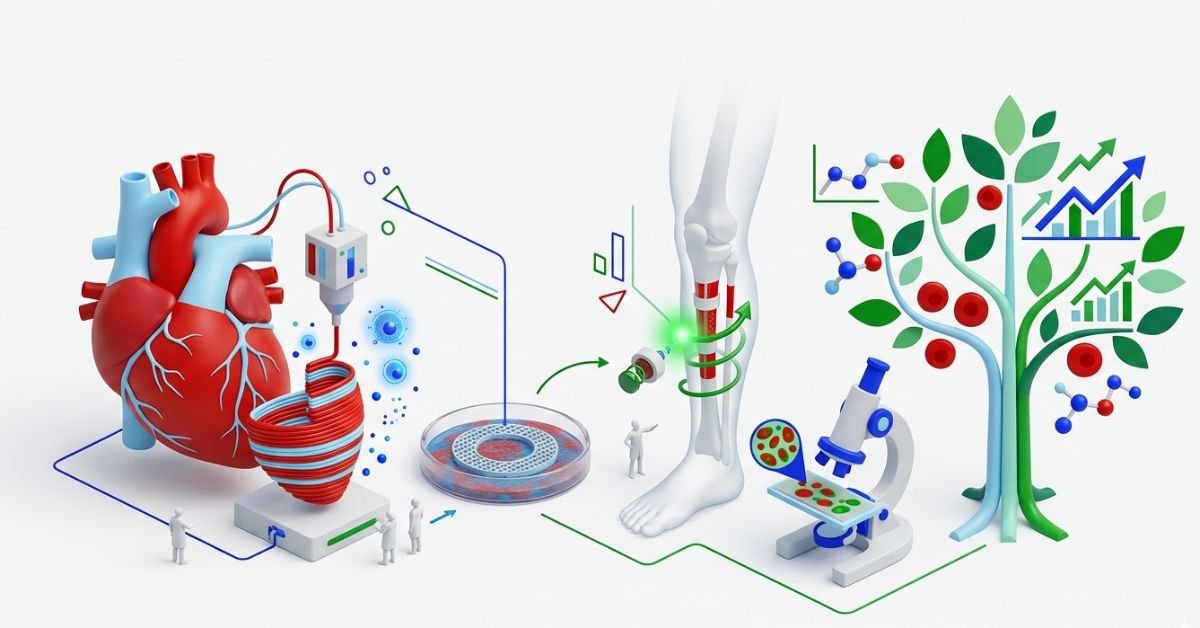
Regenerative medicine aims to repair, replace, or restore damaged tissue. It spans cell therapy, tissue engineering, gene therapy, and biomaterials. Regeneration differs from symptom management, which controls effects, and from conventional organ transplantation, which replaces an organ with donor tissue.
Therapies under one label can work by unrelated mechanisms. Blood stem cell transplants rebuild a blood system. Mesenchymal stromal cells (MSCs) mainly calm immune responses. Engineered islets replace insulin-producing cells. Each needs its own evidence.
| Approach | Mechanism | Established uses | Research stage | Principal risks | Evidence limitation |
|---|---|---|---|---|---|
| Hematopoietic stem cell transplant | Replaces blood-forming system | Blood cancers, marrow failure, inherited blood disorders | Routine care | Graft-versus-host disease, infection | Donor matching limits access |
| MSC therapy | Immune modulation | Pediatric steroid-refractory GVHD (one product) | Narrow approval, many trials | Infusion reactions, infection transmission | Single-arm pivotal data |
| Gene-edited blood stem cells | Edits patient’s own cells | Sickle cell disease, transfusion-dependent thalassemia | Approved | Conditioning toxicity, unknown long-term effects | Follow-up still maturing |
| Stem cell-derived islets | Replaces insulin-producing cells | None approved | Phase 1/2/3 | Immunosuppression, procedure risks | Small numbers |
| iPS cell-derived neurons | Replaces dopamine neurons | Conditional approval in Japan only | Early clinical | Tumor formation, graft survival | Seven-patient trial |
| Direct-to-consumer injections | Claimed repair | None | None | Blindness, infection, tumors | No credible trials |
Tier One: Established Treatment
Hematopoietic stem cell transplantation is the best-proven regenerative therapy. It treats selected blood cancers, bone marrow failure, and inherited blood disorders by replacing the blood-forming system with healthy donor or patient-derived cells.
Eligibility depends on disease, age, fitness, and donor availability. A well-matched donor, ideally matched on human leukocyte antigens, lowers rejection risk. Complications include graft-versus-host disease (GVHD), where donor immune cells attack the recipient, plus infection and organ injury. Transplant centers with specialist teams manage these risks. Coverage of the Ryoncil approval, citing its maker, put the problem at about 25% of the roughly 1,500 U.S. children transplanted each year, with nearly half of those not responding to steroids.
Tier Two: Approved for a Defined Indication
Three products show how approvals work.
| Product | Approval | Indication | Evidence base | Key caveat |
|---|---|---|---|---|
| Ryoncil (remestemcel-L) | FDA, Dec 18, 2024 | Pediatric steroid-refractory acute GVHD, age 2 months and older | Single-arm study, 54 children, about 70% overall response | Response rate, not survival comparison |
| Casgevy (exagamglogene autotemcel) | FDA, Dec 8, 2023 for sickle cell; Jan 16, 2024 for thalassemia | Sickle cell disease, transfusion-dependent thalassemia | CRISPR/Cas9 editing of patient’s blood stem cells | Label expanded to ages 2 to 11 in 2026, per Vertex |
| Lantidra (donislecel) | FDA, June 28, 2023 | Selected adults with type 1 diabetes and severe hypoglycemia | Donor-derived pancreatic islets | Needs lifelong immunosuppression |
An approval is bounded by its label. Ryoncil is not authorized for adults or for other diseases. Casgevy is a gene-edited cell therapy for specific blood disorders and is not a general regenerative treatment. Lantidra requires immunosuppressive drugs, which carry their own risks. Cost also limits reach, since single-treatment cell and gene therapies carry list prices in the millions of dollars.
FDA’s consumer page on regenerative medicine says the only FDA-approved stem cell products are blood-forming cells from cord blood. Newer approvals, including Ryoncil, post-date much of that language, so patients should check FDA’s current list of approved cellular and gene therapy products for the exact product and indication.
Tier Three: Conditionally Approved Elsewhere
Japan has granted conditional, time-limited approval to two iPS cell-derived therapies in 2026. Amchepry (raguneprocel), from Sumitomo Pharma, targets Parkinson’s disease with inadequate response to medication. A heart failure product, ReHeart, from Cuorips, received similar conditional status.
The Parkinson’s evidence came from a Kyoto University phase 1/2 trial published in Nature in April 2025. Seven patients aged 50 to 69 received bilateral transplants of dopamine-producing progenitor cells. Among six evaluated for efficacy, four improved on the motor score when off medication and five when on medication. The cells survived, produced dopamine, and did not form tumors during follow-up of 24 months.
The approval lasts seven years, during which more data must be collected. Nature reported that some researchers questioned whether a seven-patient study justifies approval. Amchepry is not approved in the United States.
Tier Four: Experimental Breakthroughs Worth Watching
Several areas have strong science and unfinished clinical proof.
| Condition | Intervention | Trial phase | Study population | Primary outcome | Follow-up | Regulatory status |
|---|---|---|---|---|---|---|
| Type 1 diabetes | Zimislecel, stem cell-derived islets | Phase 1/2/3 | 12 full-dose patients in phase 1/2 | Insulin independence, HbA1c, severe hypoglycemia | 1 year | Investigational |
| Type 1 diabetes | VX-264, encapsulated islets | Phase 1/2 | Not reported here | Insulin production | Short | Discontinued March 2025 |
| Parkinson’s disease | iPS-derived dopamine progenitors | Phase 1/2 | 7 patients | Motor scores | 24 months | Conditional, Japan only |
| Severe heart failure | iPS-derived cardiomyocytes | Early | Small | Cardiac function | Varies | Conditional, Japan only |
Zimislecel is the most closely watched. The phase 1/2 portion was published in NEJM and presented in June 2025. All 12 full-dose participants reached target glucose control, and 10 of 12 stopped using insulin after one year. All required immunosuppression. Two deaths occurred in the trial: one from cryptococcal meningitis judged related to the immunosuppressive regimen, and one from progression of preexisting dementia.
Vertex acquired the underlying technology in 2019, and first announced the product in 2021. Five years on, it has neither an approval nor, as of the latest company update, a completed pivotal trial. The pace of discovery and the pace of clinical validation are different clocks.
Progress has not been smooth. Vertex voluntarily paused dosing for an internal manufacturing analysis, resumed dosing in 2026, and said it would give updated timelines later in the year. Its encapsulated product VX-264 was discontinued in March 2025 after falling short of efficacy goals. The pattern shows why manufacturing and immune protection are as hard as the biology.
Cell Replacement and Tissue Repair
Replaced cells must survive, integrate, avoid immune rejection, and mature into functional tissue. Immunosuppression solves rejection but exposes patients to infection and cancer risk. Hypoimmune cells and encapsulation devices try to avoid it and are earlier in testing.
Gene Editing and Regenerative Approaches
Gene editing can correct or modify a patient’s cells before reinfusion, as Casgevy does. Concerns include off-target edits, durability, manufacturing complexity, and long-term safety. Follow-up over decades is not yet available for any edited-cell therapy.
How Strong Is the Evidence?
Trial phases answer different questions. Preclinical studies in cells and animals test mechanism. Phase 1 tests safety. Phase 2 looks for early efficacy. Phase 3 compares against standard care in larger groups. Postmarket surveillance watches for rare harms.
A related distinction is whether a therapy restores function, slows decline, or only moves a lab marker. Raised C-peptide proves transplanted cells make insulin. Freedom from severe hypoglycemia and from insulin injections shows restored function. Slower progression on a rating scale shows something different again, and each claim needs its own evidence.
Meaningful endpoints matter. A biomarker change, such as C-peptide, shows the cells work biologically. Insulin independence, fewer hypoglycemic events, or better function shows patient benefit. Statistically significant changes are not always clinically meaningful. Comparator groups and follow-up length also decide how far a result can be trusted. Single-arm studies, like those behind Ryoncil and Amchepry, show response but cannot prove benefit over alternatives.
Tier Five: Marketed Without Evidence
Direct-to-consumer clinics sell several products for joint pain, autism, vision loss, and other conditions. These include stem cells, fat-derived stromal vascular fraction, cord blood products, amniotic fluid, Wharton’s jelly, and exosomes. FDA states that these unapproved products, whether from the patient’s own body or a donor, have been linked to reports of blindness, tumor formation, and infections. It also notes that regenerative medicine therapies are not approved to treat autism, macular degeneration, blindness, chronic pain, or fatigue.
The most documented harm occurred in 2015, when a Florida clinic injected patients’ own fat-derived cells into the eyes of three women with macular degeneration. All three were left legally blind. In June 2019, a federal court ruled that FDA has authority to regulate such procedures.
| Intervention | Approved indication | Evidence maturity | Known risks | Availability | Verification source |
|---|---|---|---|---|---|
| Blood stem cell transplant | Defined blood diseases | Established | GVHD, infection | Specialist centers | Transplant program |
| Ryoncil | Pediatric SR-aGVHD | Approved, single-arm data | Reactions, infection | Specialist centers | FDA label |
| Zimislecel | None | Late-stage trial | Immunosuppression | Trial only | ClinicalTrials.gov |
| Clinic fat or cord injections | None | None | Blindness, tumors, infection | Commercial | FDA warnings |
Commercial availability does not prove approval or efficacy. Prices of several thousand dollars for an injection are a red flag, as are testimonials in place of trial data.
How Patients Can Verify a Treatment
Four checks reduce risk. Search FDA’s list of approved cellular and gene therapy products for the exact product and indication. Look up the study on ClinicalTrials.gov and confirm it is registered, recruiting, and does not charge participants. Ask the clinic for its FDA or national regulator status in writing. Seek a second opinion from an unaffiliated specialist.
Risks, Costs, and Barriers
| Risk or barrier | Mechanism | Affected treatments | Mitigation | Unresolved question |
|---|---|---|---|---|
| Immune rejection | Host attacks foreign cells | Donor islets, neurons | Immunosuppression, hypoimmune cells | Long-term infection and cancer risk |
| Tumor formation | Cells proliferate abnormally | Pluripotent-derived products | Purification, monitoring | Decades-long safety |
| Manufacturing variability | Batch differences | All cell products | Good manufacturing practice | Scale-up consistency |
| Cost | Complex production | Gene and cell therapy | Outcome-based payment | Equitable access |
| Procedure risk | Surgery, conditioning | Transplants, brain grafts | Specialist centers | Patient selection |
Manufacturing and long-term safety matter as much as the first biological response. Vertex’s pause illustrates it.
What Could Change by 2030
A credible pipeline exists for diabetes, Parkinson’s disease, heart failure, and blood disorders. Whether zimislecel or related products receive approval, and whether hypoimmune designs remove the need for immunosuppression, will shape the next phase. Scaling, reproducibility, and equitable access are open problems. These are possibilities, not promised outcomes.
Conclusion: Durable Benefit Defines a Breakthrough
Established regenerative treatments differ sharply from experimental ones, and the differences determine what a patient should do. Progress in cell replacement and tissue engineering is real. Manufacturing, long-term safety, cost, and access remain the barriers. A genuine breakthrough shows durable clinical benefit, not biological promise alone.
Medical Disclaimer: This article is educational and cannot determine individual treatment eligibility. Consult qualified specialists before considering cell-based or experimental interventions.
FAQ
Q: What is regenerative medicine?
A: It is a field aiming to repair or replace damaged tissue using cell therapy, tissue engineering, gene therapy, and biomaterials.
Q: Which regenerative treatments are currently established?
A: Blood stem cell transplantation is the most established. Approved products such as Ryoncil and Casgevy cover narrow indications.
Q: Can stem cells repair damaged organs?
A: Not as a routine treatment. Organ repair with stem cells remains experimental, apart from selected approved uses.
Q: How are regenerative therapies tested?
A: Through preclinical studies, then phase 1 to 3 trials, then postmarket surveillance.
Q: What are the risks of unproven stem cell treatments?
A: FDA has received reports of blindness, tumor formation, and infections linked to unapproved products.
Q: How can patients check whether a treatment is approved?
A: Search FDA’s approved cellular and gene therapy list and ClinicalTrials.gov, and ask a clinic for written regulatory status.
Q: Why are regenerative treatments often expensive?
A: Production is complex, individualized, and held to manufacturing standards, and some products treat small patient groups.
Q: Which areas of regenerative medicine are still experimental?
A: Stem cell-derived islets, iPS-derived neurons and heart cells, and tissue-engineered organs